
CONNECTICUT HOCKEY PARENTS: READ THIS CAREFULLY
This isn’t about coaches.
This isn’t about ice time.
This isn’t about practice plans.
This is about us.
The Hard Truth
On a per‑capita basis, Connecticut — along with New York and New Jersey — produces far fewer high‑level hockey players than comparable regions.
That includes:
- NCAA Division I
- National team representation
- NHL development pathways
For years, the explanation has always been external:
- “The coaches aren’t good enough.”
- “The practices aren’t structured right.”
- “We don’t have enough ice.”
- “The Midwest has better visibility.”
Those explanations are comfortable.
They are also incomplete.
I Went Looking for the Real Reason
Like many of you, I once believed the “Minnesota Model” explained everything — free play, community rinks, less pressure.
Then I went there.
The parents are just as intense.
The stakes are just as high.
The difference is not effort or execution.
So I kept digging.
What the Data Actually Shows
When you look at hockey outcomes globally and domestically, one pattern keeps showing up:
High income inequality → low trust
Low trust → weak team‑sport development
This isn’t theory.
This is measured.
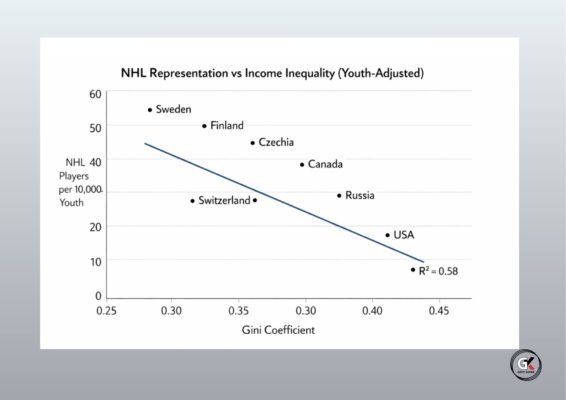
Countries with:
- Low inequality
- High social trust
Produce far more elite hockey players per registered youth player than countries with:
- High inequality
- Low trust
The United States ranks worst among major hockey nations on this measure.
That should stop everyone cold.
Why Trust Matters in Hockey
Hockey is not an individual sport.
It requires:
- Sacrifice without immediate reward
- Trust that your teammate will do their job
- Willingness to defer credit
- Comfort being uncomfortable for the group
If kids are raised in environments where:
- Everything is transactional
- Adults intervene constantly
- Teammates are viewed as competitors
- Every shift is an audition
- Individual achievement is celebrated on social media
Then trust never develops.
And without trust, elite team performance collapses.
Trust Is Measurable
To test this, I looked at characteristics of high‑trust and low‑trust societies using the World Bank survey that asks:
“Generally speaking, would you say that most people can be trusted?”
Not surprisingly, we see Finland and Sweden at the top of the trust scale.
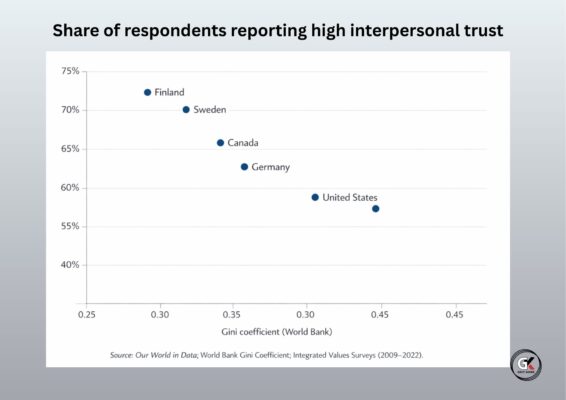
Highperforming hockey nations rank highest in trustHighperforming hockey nations rank highest in trust
So now we can connect the chain:
High inequality → low trust
Low trust → poor team‑sport outcomes
This is not philosophical.
It is structural.
Now Apply This Locally
If this relationship is real, we should see it inside the United States as well.
I applied the same framework at the state level:
- State income inequality
- Adjusted NCAA Division I representation
- Youth registration as the denominator
The result?
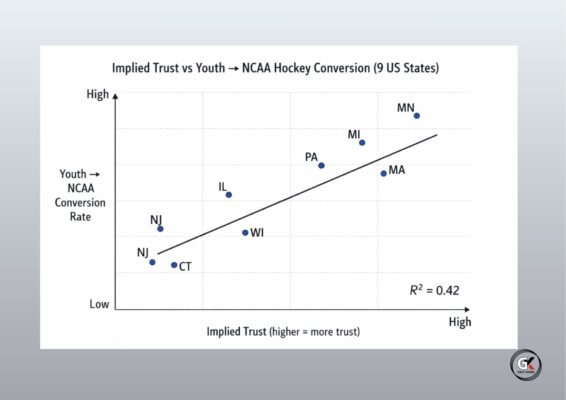
The NY–NJ–CT region underperforms every major hockey state.
At that point, the conclusion becomes uncomfortable.
The tri‑state area is the worst high‑level hockey‑producing region in the country.
Not because kids don’t work hard.
Not because coaches don’t care.
But because the environment undermines team behavior.
The Projection Trap
When confronted with this, the instinct is to project outward:
- Blame coaches
- Change teams
- Add privates
- Demand more ice
- Control outcomes
That instinct is part of the problem.
You cannot coach trust into a player if it is undermined at home.
The Code (And Whether We Live It)
Ask yourself honestly:
- Do we allow kids to fail without intervening?
- Do we let coaches coach?
- Do we value team success over individual visibility?
- Do we model restraint, patience, and humility?
- Do we treat teammates as partners, not obstacles?
If the answer is no, that’s okay.
But then step aside and let the environment teach what you cannot.
The Bottom Line
Private coaching.
Over‑management.
Early specialization.
Constant comparison.
Adult‑driven careers.
The data is clear:
None of it works in the long run.
Elite hockey players come from environments where:
- Trust is earned
- Roles are accepted
- Sacrifice is normalized
- Adults do less, not more
Final Word
Enjoy your kid’s journey as a passenger, not the driver.
Let coaches teach the Code.
Let teams function as teams.
Let kids learn to trust each other.
Because the data is telling us something powerful — whether we like it or not.
Team sports like hockey are an invaluable vehicle for teaching kids about life.
They teach trust.
They teach sacrifice.
They teach how to be part of something bigger than yourself.
But only if adults allow it.
Please let the game, and the Code, do its job.
Find. A. Way.
— Greg
This article is part of our Hockey IQ: Complete Guide.
