
I’ve skated alongside some legends, stood in locker rooms, watched ex‑NHL players do wild things, but Alex Kovalev always hovered at the edges of myth. Over the last 25+ years, our paths crossed: I’d see him during his Rangers rehab skates or later in the local men’s league. Rumor had it he was the guy who showed up to a skate in full gear, made moves that twisted physics inside out, left you wondering if you blinked, took his skates off and hopped in his car while wearing the rest of his gear. He was like the Keyser Söze of rinks.
I’d talk to him now and then, just in passing. But there was always something different about him, something you couldn’t quite name. He was enigmatic, less like a player grinding reps and more like an artist shaping something original. His creativity didn’t just show up in the kind of highlight-reel moments we’re used to now, those tightly edited snapshots we scroll through on mini reels. It was in the pauses, the transitions, the plays that effortlessly shifted the direction of the game, moments no one else even noticed, turning tight corners into openings and creating opportunities out of situations that looked dead. It drew me in.
I couldn’t stop thinking about it. What was he seeing that others didn’t? I kept circling one question: Where does creativity in hockey actually live?
From Basics to Breakthroughs
There are no skill sessions, no YouTube trick, no blog sentence that will plant creativity in a player’s heart. Trust me, I’ve looked. I’ve spent years digging into player creativity from every possible angle: as a goalie, a coach, and a curious observer of how artistry shows up in sports. I studied the mindset of artists, inventors, and master craftsmen. I dove into cognitive science, learning how the brain builds patterns and where creative insight originates in our thoughts. It took years of reading, exploring, failing, and connecting dots across disciplines.
The turning point for me was On Creativity by David Bohm. His core idea stuck with me: real creativity isn’t about being unpredictable, it emerges from mastering the fundamentals so deeply they become second nature, almost invisible. As Bohm wrote, “Creativity emerges as a result of a mind that is in a state of normal order, not from a deliberate effort to achieve it.” His core idea stuck with me: real creativity emerges from mastering the fundamentals so deeply they become second nature, almost invisible.
That’s Alex. He didn’t just skate; he felt axes, angles, empty spaces. He internalized hockey’s grammar so deeply he could rewrite it mid‑play.
The Teammate Joke & the Artist Lens
Now how does an artist like Alex connect with the team, with The Code of hockey? I’ll own this, when I asked a handful of buddies who played pro hockey about hockey culture, I joked that maybe Alex “didn’t know he had teammates and performed more like a solo artist.” But that was from viewing him through the traditional lens. When I shifted my view, I saw him not just as an artist, but as the front man of a band, or better yet, the conductor of an orchestra—I understood.
He wasn’t ignoring the team. He was interpreting the game on a different frequency, one where the structure of hockey became the framework for improvisation, not limitation. He was playing a version of the game we hadn’t even imagined, pushing boundaries, searching for deeper connections, creating harmony from chaos. His style wasn’t about standing apart; it was about pulling everyone into the rhythm, teammates and spectators alike. Instead of just exuding style, he wove it into the fabric of the team’s movement, drawing others into the flow of his vision and elevating the collective game.” I understood. He was playing a version of the game we hadn’t even imagined, pushing boundaries, and searching for connections.
The Sun, the Stars & Hockey Vision
Let’s visualize this. Imagine a night sky inside every player’s mind. Each star is a building block of hockey—skating, passing, timing, positioning. The sun (skill) illuminates those stars. It powers the ability to see the constellations of hockey plays, more patterns, more possibilities.
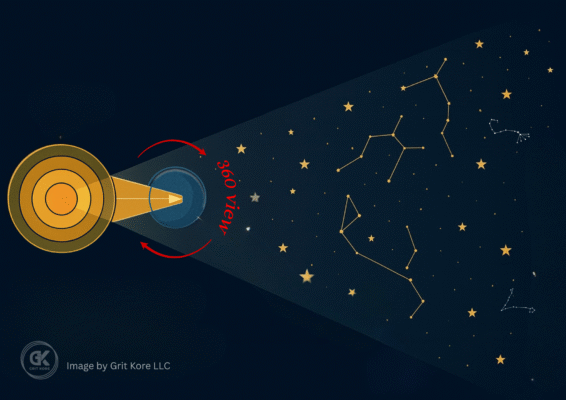
When a player only focuses on gaining skill, they’re staring directly at the sun. And when the sun is that big and that bright, there’s not much else to see—just the intense glare of the skills they’re chasing. In other words, the stars are harder to see and the constellations, hockey plays and connections between the stars, are fainter.
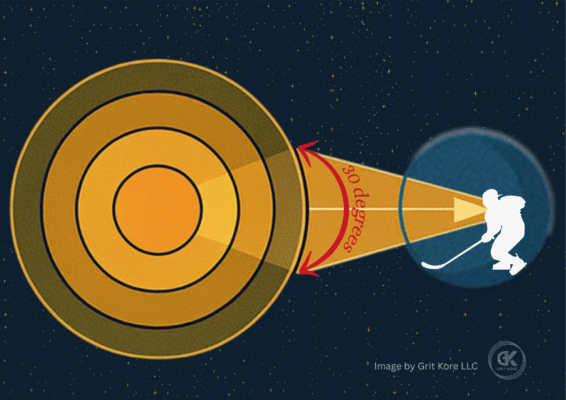
What separates the artist from the rest isn’t just the skill, it’s the ability to look up, look around, and take in the full 360-degree view. To notice the constellations, to see how those stars connect, to recognize the new opportunities that skill has now made possible.
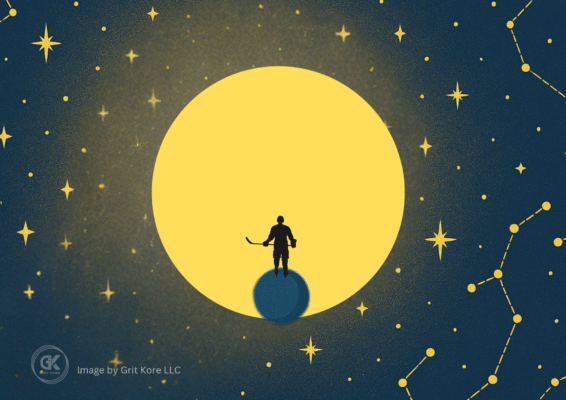
Alex stared at that hockey night sky and trained to push the edges. He didn’t just solve the play in front of him; he asked, “Which new skill would change how I see this play altogether?” His motivation to learn new moves always came with purpose. It wasn’t, “how many tricks can I collect?” but, “what play can I make now that I couldn’t make before?”
Don’t Chase Tricks—See the Whole Ice
That mindset is light years away from the youth sports treadmill, where kids chase moves just to make the team. When you chase skill without purpose, you risk ignoring the constellations. You stare at the sun so long, you forget the stars—the plays, the creativity. And when that happens, even the flashiest moves get hollow fast.
But here’s the thing: how many kids are really going to be an artist like Alex? What are the odds that today’s players reach that level of vision and ability?
Let’s hit the cold math:
- Bleacher Report places Alex (AK27) among the Top 6 skill players since 1967.
- Say, generously, there’s one “Kovalev-level” talent per birth year.
- Worldwide players per birth year: ~138,600.
- NHL hopefuls per birth year: ~123.
- That gives ~0.09% chance to reach the NHL.
- To be Kovalev-level? ~0.0007%.
It’s a bleak but accurate assessment: your child statistically has a better shot at being struck by lightning and winning the Stanley Cup than becoming another AK27.
So why do we obsess over skill as if it’s the finish line? A beautiful move that loses the puck is still a turnover. An “ugly” heads-up play will still win the moment. Seeing the wholeness of the game-how the rink’s geography, the game’s rules and momentum flow together can’t be imparted at a skills session. And these attributes are just as, or more important, than the jump-stop dangle against an inanimate object.
A Parent’s Call: See the Stars First
Before you decide your kid “needs more skill,” ask why they play. To win early? Make the A team? Keep pace? Or because they love the game, enough to look up and see the constellations?
Creativity comes from a passion that makes them want to figure out how to truly see the game and discover new constellations.
If we want smarter players, creative, instinctive, high‑IQ players, we must stoke the fire first. The rest follows. Help them:
- Fuel passion: Learn skills to reveal the infinite sky.
- Chase meaningful skills: Grow the sun to reveal more stars.
- Connect dots: Create, don’t just replicate.
If there’s one common denominator in Alex’s game, it’s passion. His obsession with how things worked at the tiniest level gave him freedom to create in ways others couldn’t. In his own words, he didn’t want to play like those who came before, he wanted to reshape the game entirely.
If passion was the spark, and skill the tool he used to expand his vision, then we need to rethink how we guide our kids. Why do we push skill before nurturing curiosity?
Find. A. Way
Greg
