
But… it’s actually kinda funny) Let’s be honest.
Two of the dirtiest little secrets in youth hockey:
1️⃣ Mite parents absolutely know the score of every game
2️⃣ Everyone says rankings “don’t matter”… while secretly refreshing them like the stock market
When my boys were in Mites, I’d hear legends about managers rearranging schedules like chess grandmasters just to boost a ranking. And people like me? We’d roll our eyes and say:
“Relax… most of these kids won’t even play high‑level hockey anyway.”
BUT… I couldn’t leave it alone.
Do PeeWee Major (U12) rankings actually predict future success?
So I dug in. I pulled old MyHockeyRankings data, matched it with PeeWee Quebec rosters, and tracked where those kids ended up using hockeydb. Honestly, I was fully expecting to prove rankings were meaningless. Instead… I proved the opposite.
What the data actually showed
The higher the team ranking, the more players eventually reached high‑level hockey. It wasn’t subtle, it looked almost like a perfect probability curve.
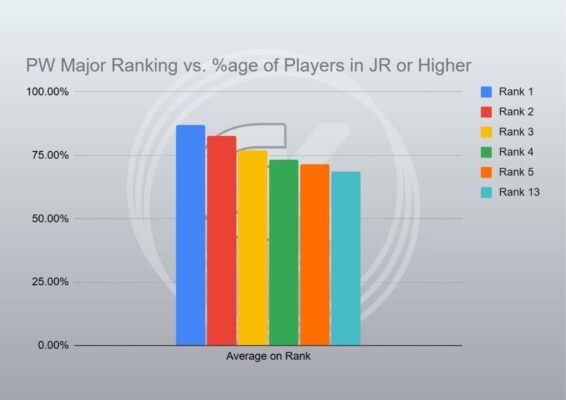
But here’s the important part: Rankings don’t create great players — great players create the ranking. Top teams usually have top athletes, deep pipelines, and better early development. The ranking is just a reflection of what’s already happening on the ice.
Where things get blurry…
Here’s where parents can accidentally lose the plot.
In some areas, the “race to the top team” starts way too early:
🏒 kids on the ice with private coaches multiple times a week before kindergarten
😤 parents scolding 8‑year‑olds for “poor effort” (I was once asked to ‘get in my five year-old’s face’. I declined.)
💰 effort traded for privilege like it’s a contract negotiation
🎥scrutinizing every Livebarn clip
And here’s the twist:
None of this may actually be the reason those teams are ranked high. In many cases, the kids on top teams are simply the best natural athletes in the area. Before fast‑tracking your kid into a small army of private lessons so they can make a top‑10 team at 12… ask yourself:
“Was I one of the fastest runners in 5th or 6th grade?”
It sounds silly, but it’s a shockingly good proxy for raw athleticism.
And athleticism matters.
A lot.
But it’s still not everything.
And then I texted Matt Moulson…
After swallowing my pride, I messaged Matt Moulson (11 NHL seasons, Cornell, featured in our illustrated book MattyMo’s Grit Pile) and asked:
“What year did you get cut from the top youth team in Canada?”
Long pause…
Then:
“PW Major.”
If we believed rankings determined destiny, Matt would’ve been finished right there.
But the difference wasn’t the cut — it was his reaction.
There are two ways kids respond to being cut:
🥀 Victim mode:
“Coach is out to get me.”
🔥 Accountable mode:
“This is where I’m at. Time to work.”
Matt chose the second.
No excuses.
No blaming.
Even though his best friend’s dad cut him.
He wasn’t ready yet — and he owned it.
Then he went to work.
Every day.
Earned his grit instead of blaming others for not seeing what he saw.
The Real Conclusion
Rankings don’t define players. Players define rankings.
A cut isn’t a dead end, it’s a moment of truth.
Some kids break.
Some kids build.
And the ones who build?
They’re the ones who write their own ranking.
Find. A. Way.
Greg
