
What the Data (and the Kids) Are Telling Us
One of the perks of being a hockey geek who actually tracks what happens on the ice is that you get to move past opinions and look at reality. Numbers don’t lie, but they also don’t tell the whole story unless you know how to read them.
A few weeks ago, we talked about how half-ice and full-ice games both have real benefits. After reviewing our latest Grit Score data, that conclusion still holds true, but with an important twist.
Here’s what we’re seeing:
- Total Grit Scores are higher on half ice
- Energy, engagement, and excitement are higher on full ice
And in a long hockey season, both of those things matter.
What We Measured
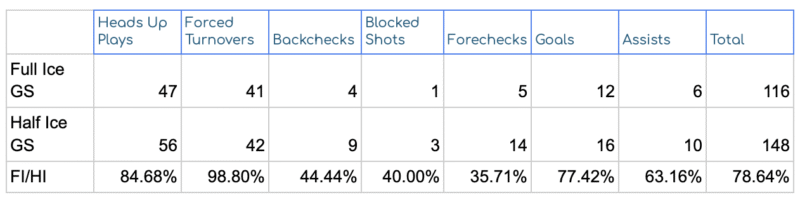
We compared one full-ice game against the average of two half-ice games versus the same opponent. Here’s what showed up:
What This Really Means
The fundamentals, heads-up plays and forced turnovers, are almost the same on both surfaces. That tells us the kids are still competing and reading the game.
But the “grit behaviors”, backchecks, forechecks, and blocked shots, drop way off on full ice. That’s because half ice creates more:
- puck touches
- decision-making
- close-quarter battles
- repetition
From a pure development standpoint, half ice is incredibly powerful.
But here’s the part that doesn’t show up in a spreadsheet.
The Human Factor: Energy & Engagement
We’re deep into the season now. Bodies are tired. Minds are tired. And kids want to feel like they’re playing real hockey.
When a kid stops having fun, their brain — especially the prefrontal cortex, the part responsible for focus, learning, and self-regulation — starts to shut down. You can give them all the reps in the world, but if they’re not emotionally engaged, those reps don’t stick.
That’s what we’re seeing on half ice right now. The kids are going through the motions.
Full ice changes that.
It feels new.
It feels bigger.
It feels like “the Show.”
And suddenly kids are:
- thinking about their shifts
- replaying moments in their head
- caring about positioning
- wanting to improve
That mental activation is just as important as physical reps.
So What’s the Takeaway?
This data doesn’t say half ice is wrong.
It says timing matters.
Early in the season, half ice is gold for skill development.
As the season wears on, kids need a spark — and full ice gives them that.
If anything, this supports a simple, kid-centered approach:
Start small. Build skill. Then expand the game as their minds and motivation need a lift.
That’s how you keep kids growing, engaged, and loving the game — which is what motivates them to earn grit daily.
Find. A. Way.
Greg
Grit Kore Hocky Skills and Hockey IQ books click here
