
Every hockey coach I talk to can’t stop talking about the way Team Finland played at the World Juniors.
They punch well above their weight in NHL representation. And for years, USA Hockey has studied the Finnish model—trying to decode what people often label as “skill development.”
But here’s the reality check.
If Finnish players were simply more skilled individually, you’d expect them to dominate the NHL’s skills competitions. They don’t. In fact, only a small handful of Finns have ever been singled out as true outliers in those events—the most famous example being Teemu Selänne, who stood out in the 1998 Puck Control Relay.
So if it isn’t raw stickhandling trophies… what is it?
What separates Finland shows up somewhere else entirely: five‑man connection, trust under pressure, and structure that doesn’t break when the game gets hard.
And yet, there’s still something the Finns do that we don’t quite replicate.
I recently had a great conversation with Vladislav Bespomoshchnov (Norwegian School of Sport Sciences) who half‑jokingly said:
“You know you’re watching Team Finland because you see all five players in the picture frame.”
That line stuck with me, because it says everything.
Sisu: The Mindset Behind the Five‑Man Game (why Finland punches above its weight in hockey)
🇫🇮 Finland plays a TEAM game, and that’s not accidental, it’s cultural.
Finnish hockey is powered by a team mindset which can be captured in one word. sisu.
There is no direct translation in English. The closest comparison is grit, but even that falls short in some aspects. Sisu is a quiet, non‑wavering determination, the stubborn, unbreakable ability to keep going beyond perceived limits, especially when the odds aren’t in your favor. It isn’t loud. It isn’t flashy. It doesn’t need recognition. It’s about doing the work anyway and letting actions speak.
That mindset shows up every shift in Finnish hockey.
When Finland gets pinned in their zone, they don’t panic.
When they’re down a goal, they don’t freelance or cheat for offense.
They stay connected and focused as a team. They trust the next play. They keep coming, shift after shift. That’s what sisu looks like on skates.
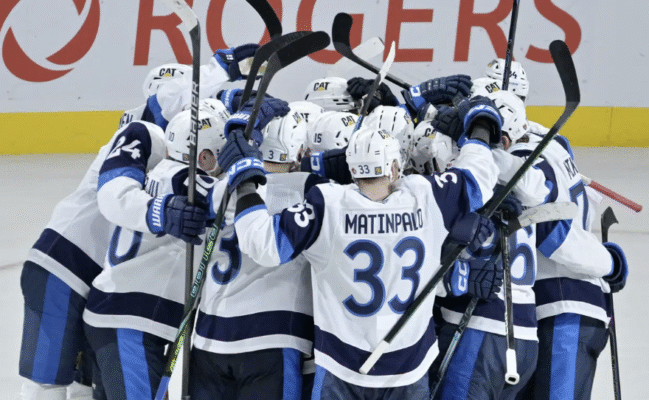
Hockey Is the Ultimate Team Sport
I’ve always believed hockey is the ultimate team sport. You can’t hide. You can’t cherry‑pick. You can’t win without defending, supporting, and trusting the other four players on the ice.
I’m also an economist by training, which led me to ask a different question:
Are some countries naturally better aligned with team hockey, not just through coaching systems, but through how their societies function?
In other words, what if we copied the Finnish development model exactly, but dropped it into a different social environment? Would we still get Finnish‑style hockey?
Probably not.
Before asking what we should copy, we need to understand who we are.
A Quick Economics Detour (Stick With Me)
If you took economics at any point, you may remember the Gini coefficient, a measure of income inequality.
Lower Gini → more equal societies
Higher Gini → larger income gaps
When we look at the countries competing at the World Juniors, a pattern emerges:
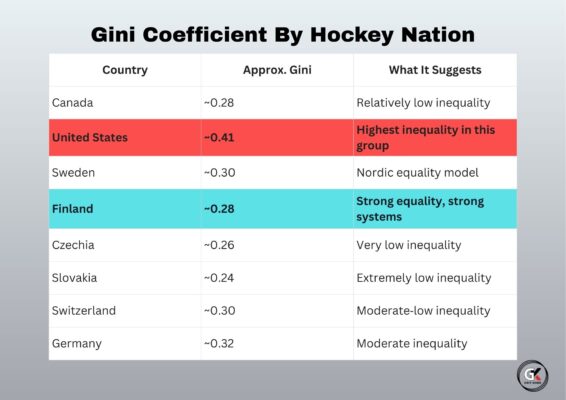
The United States stands out immediately.
Zoom in even further, to hockey hotbeds like the Gold Coast of Fairfield County, and estimated Gini coefficients approach 0.60. That’s extremely high.
Why This Matters for Hockey
Income inequality doesn’t just shape economies.
It shapes behavior.
In higher‑inequality environments, people can buy independence:
- Private coaches
- Private skills trainers
- Private solutions to shared problems
In lower‑inequality environments, people rely more on:
- Systems
- Teammates
- Shared responsibility
That difference shows up on the ice.
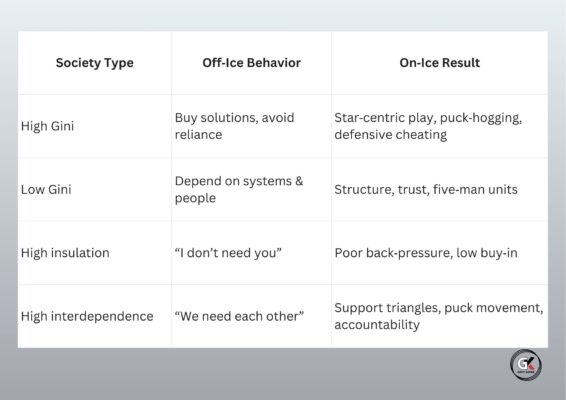
This isn’t a value judgment. It’s a structural reality, and like any experiment, you don’t get the same outcome unless you recreate the same environment.
The Leafs Problem (Yes, I’m Going There)
I’ll admit it, I love beating up on the Leafs.
During the Auston Matthews era, Toronto’s roster Gini hovered around 0.50.
By contrast, recent Stanley Cup champions typically sit in the 0.42–0.47 range.
In plain language:
Cup winners have a bigger middle class.
More role players.
More shared responsibility.
Less dependence on one star solving everything.
That’s team hockey.
So What Should Parents Take Away?
Hockey is hard.
It demands offense and defense.
It demands trust, sacrifice, and interdependence.
If we live in highly unequal environments, we shouldn’t be surprised when:
- Players struggle with defensive buy‑in
- Kids over‑prioritize individual skill
- Team concepts take longer to click
Maybe the answer isn’t copying Finland’s drills.
Maybe it’s:
- Teaching the Code
- Valuing systems over shortcuts
- Spending less time chasing private fixes
- Spending more time teaching kids how to rely on each other
Because at the end of the day, hockey doesn’t reward insulation. It rewards connection.
“Sisu is something that can’t be bought or copied, it’s built through shared struggle, a mindset to show up when your team needs you most.”
Find. A. Way.
— Greg
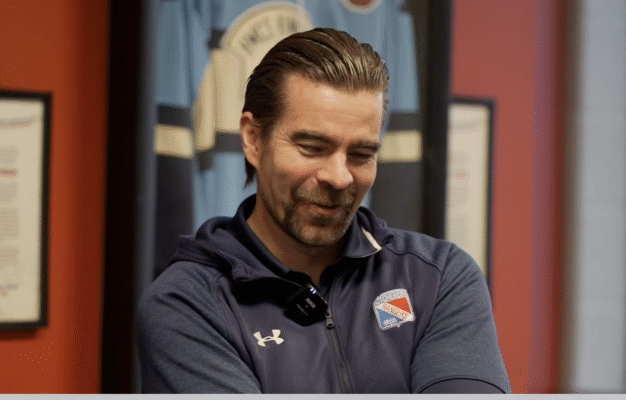
Watch Jussi Ahokas (Kitchener Rangers (OHL)) In episode 238 of the Glass and Out Podcast share the Finnish concept of “Sisu,” why you’ll always get better results when people enjoy the enviornment and why positionless hockey is the future of the game. Click here.
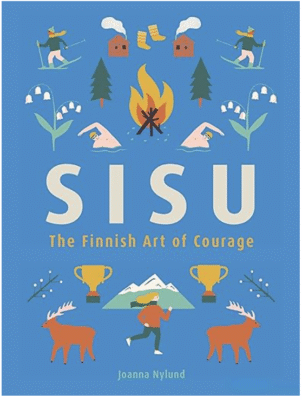
by Joanna Nylund

Pingback: Why NY, NJ, and CT Lag in Elite Hockey Development (And It’s Not Coaching) - Grit Kore