
Youth hockey tryouts in Fairfield County reveal something fascinating every year. Parents become anxious, conversations become tense, and behaviors sometimes emerge that seem… out of character.
Which raises a strange question.
Why are parents so emotionally invested in something they are not actually participating in?
The players are the ones trying out. Not the parents.
Yet the reactions often suggest something deeper is happening.
To understand it, we have to ask a bigger question:
What is identity?
The Beginning
At the beginning of human history, identity was simple.
We lived in small tribes where survival depended on cooperation. Your place in the group depended on being capable and reliable. If you could contribute, you belonged.
Your identity wasn’t something you announced.
It was something the tribe observed through your actions.
Fast forward a few million years and the world looks very different.
Modern life is large, complex, and often anonymous. Many of us are no longer evaluated daily on whether we can help the tribe hunt, build shelter, or protect the group.
In that environment, it’s easy to feel… a little untethered.
How Identity Actually Forms
Identity doesn’t appear magically. It grows through experience.
It usually follows a cycle that looks something like this:
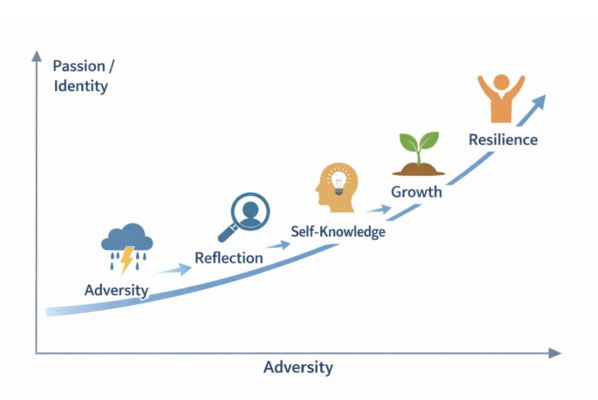
When we encounter difficulty, we are forced to reflect. Through reflection we learn our strengths and weaknesses. That understanding produces growth, which builds resilience.
And then the cycle repeats.
Over time, that cycle produces something powerful:
a stable sense of self.
Why Failure Matters
If this model is correct, failure is not something to avoid.
It’s actually the starting point of identity development.
Which means the early years of childhood should probably contain plenty of:
- setbacks
- disappointment
- difficult lessons
These experiences are not harmful. They are the raw material of identity.
What We Sometimes See Instead
Watching youth hockey tryouts, however, sometimes reveals a different pattern.
Parents scrambling to move teams.
Parents lobbying for roster spots.
Parents constructing elaborate explanations when outcomes don’t go their way.
Interestingly, the kids themselves often seem relatively unaffected.
Which raises another question:
If the child can tolerate the disappointment, who is the distress really coming from?
When Parents Lose Their Own Identity
A common path in modern life looks something like this:
- We go to school and begin forming our identity.
- We start a career and continue developing it.
- Then we have children.
And something subtle sometimes happens.
Our own identity development slows down or even pauses while we focus entirely on our children.
When that happens, something tempting appears: pre‑packaged identities.
“Hockey family.”
“Travel team parent.”
“Elite program.”
Without realizing it, our sense of self can become tethered to our children’s activities.
When that activity becomes uncertain — like during tryouts — it can feel like our own identity is suddenly under threat.
Why This Matters
The irony is that this behavior can unintentionally interfere with the very thing children need most.
Children build identity the same way adults do:
Through adversity.
When we try to remove every disappointment, protect every outcome, or engineer every path, we may actually be interrupting the cycle that builds resilience.
The Real Opportunity
Youth sports are not just about winning games or making teams.
They are incredible environments for learning:
- effort
- humility
- persistence
- failure
- growth
But that only works if both kids and parents are willing to tolerate the discomfort that comes with it.
The Challenge for Parents
Maybe the real lesson of tryout season isn’t about the kids at all.
Maybe it’s a reminder for parents.
To continue building our own identities.
To tolerate uncertainty.
To let our kids experience adversity.
And perhaps most importantly:
To remember that our children’s journey does not define who we are.
Find. A. Way.
Greg
