
Every season we try to anchor our team with a theme—something that captures how we want to play and who we want to be.
A few years ago, that word was grit.
It fit the game perfectly. Hockey is a little grimy. A little chaotic. It rewards the player who keeps going when things aren’t clean.
But when we tried to define grit, it got surprisingly hard.
The more we talked about it, the more vague it became.
Around that same time, we were working on a series of children’s books with former NHL players Matt Moulson and Mike Komisarek—guys who played over a decade of pro hockey, despite taking very unlikely paths to get there.
We spent hours talking with them.
Not about systems. Not about skill.
About how they actually made it.
And a pattern kept showing up.
They all had:
- a deep passion for the game
- an unrelenting commitment to their craft
- a strong sense of accountability
But those things weren’t enough on their own.
What tied everything together was something else:
They could handle discomfort.
They could take failure, pressure, doubt, bad games, setbacks—and keep going anyway.
So we tried to simplify it.
If you think about it structurally:
Grit = DT × P × C × A
Where:
- DT = Discomfort Tolerance
- P = Passion
- C = Commitment
- A = Accountability
The key variable is DT.
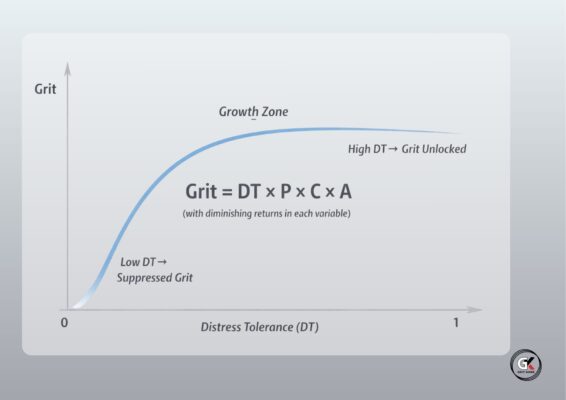
Because without it, the rest don’t hold up.
You can be passionate—but quit when it gets hard.
You can be committed—but fade under pressure.
You can be accountable—but get defensive when things go wrong.
Discomfort tolerance is what allows the other traits to actually show up.
The higher it is, the deeper everything else can go.
So if that’s true, the question becomes:
How do we build it?
Not through speeches.
Not through motivation.
But through experience.
- Let kids fail—and let them respond
- Encourage them to chase something difficult
- Remove shortcuts
- Model it ourselves
I used to think we connected because of hockey.
We didn’t.
We connected because we share a higher tolerance for discomfort.
That pulls you closer to reality—
and reality is where better conversations happen.
If we want our kids to grow, we have to let them get uncomfortable.
That’s what brings them closer to reality—where they learn their strengths, their weaknesses, and who they really are.
That’s where they push themselves.
That’s where they grow.
Our job isn’t to make it easier.
It’s to stand beside them while they go through it.
Because the more we protect them from discomfort,
the more we hold them back from developing grit.
Find. A. Way.
Greg
What Discomfort Tolerance Looks Like Day to Day
It rarely shows up as a big moment. It shows up as:
- Staying on the ice for the drill you’re bad at, not just the one you’re good at.
- Sitting with a bad shift instead of arguing the call.
- Finishing the rep everyone else is skipping.
None of those make a highlight reel. That’s the point. Discomfort tolerance is built in the parts of practice nobody’s filming. And every time a kid chooses to stay in it instead of check out, DT goes up a notch, and passion, commitment, and accountability all get a little more room to do their job.
Frequently Asked Questions
What does “DT × (P + C + A)” actually mean?
It’s our shorthand for how grit works. Passion, Commitment, and Accountability matter, but Discomfort Tolerance (DT) is the multiplier; without it, the other three traits fold under pressure instead of holding up.
Can discomfort tolerance be taught, or is it something kids either have or don’t?
We believe it’s built through experience, not speeches. Letting kids fail and respond, encouraging them to chase something hard, and removing shortcuts all raise DT over time.
Isn’t it a coach’s job to make things easier for young players?
Not in the way that helps most. The core argument here is that protecting kids from discomfort holds back the very trait, grit, that we’re trying to build.
How is this connected to the “Grit Score” mentioned elsewhere on the blog?
The Grit Score tallies the visible actions, backchecks, blocked shots, and so on, that usually require some discomfort tolerance to execute. This post is about the internal trait; the Grit Score is one way we try to measure its output on the ice.
This article is part of our Mental Toughness & Grit: Complete Guide.
