
In a world of constant comparison, identity is under pressure, and grit is what holds it together.
We’ve all heard it:
“Kids these days aren’t built like we were.”
And honestly… that’s true.
But not for the reason people think.
It’s not that kids are softer.
It’s that they’re growing up in a completely different environment—one we weren’t built for either.
How We Got Here
Go back 150 years.
Your world was small.
- You were the farmer’s kid
- The blacksmith’s kid
- The best (or worst) at something… within a 10-mile radius
And that was enough.
Your identity was:
- local
- stable
- rarely challenged
You didn’t wake up wondering how you compared to the top 1% of humanity.
Then came radio.
Suddenly, you became aware:
“Oh… there are other ways to live.”
But still—your actual competition stayed local.
Then TV showed up.
Now you didn’t just hear about other people—you saw them.
- better athletes
- better looking people
- better lives
Comparison started creeping in.
Then came the internet.
Then social media.
And now?
A 12-year-old kid can compare themselves to:
- the best athlete
- the funniest creator
- the most attractive person
- the richest lifestyle
…all before lunch.
The New Reality
Kids today don’t grow up thinking:
“I might be the best.”
They grow up knowing:
“There are thousands of people better than me.”
Even if that’s just a snapshot in time.
That changes things.
Because it introduces pressure before identity is fully formed.
Social Media and Mental Distress
Now layer this on top:
- constant exposure
- constant comparison
- constant feedback
It’s like getting performance reviews… all day… for your entire life.
Even for things you don’t care about.
That’s exhausting.
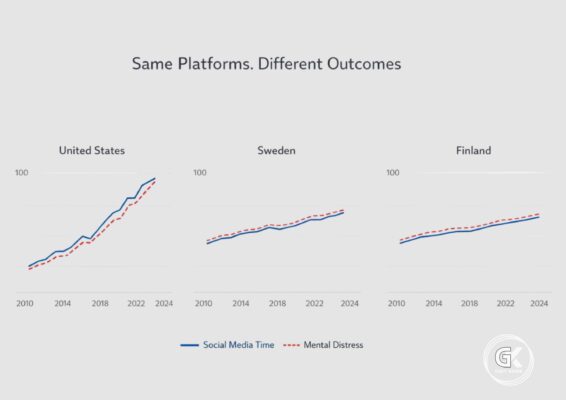
What the data shows
Across countries like the U.S., Sweden, and Finland, we see:
- social media use increasing
- mental distress increasing alongside it
Not perfectly.
Not causation.
But directionally—especially in the U.S.—it’s hard to ignore.
The Identity Formula (Simplified)
Here’s the idea in plain English:
Identity grows when kids do real things, consistently, even when it’s hard.
And it slows—or even reverses—when:
- they’re doing things just to be seen
- they don’t actually care about what they’re doing
- they start believing they’re “not good enough”
- they avoid discomfort
If you want the formula:
Identity Growth = (Capability × Real Effort × Tolerance for Discomfort^2)
– (Performing for others + Negative self-perception × Avoidance)
Yeah… it looks like math.
But it’s actually pretty simple:
Do real things + stick with them = growth
Fake it + avoid hard things = drift (or worse)
Where It Goes Wrong
Here’s the subtle trap.
Kids are actually pretty good at just… doing things.
- playing
- trying
- improving
They don’t naturally sit around thinking about their “personal brand.”
But then adults step in.
- “Look at this kid”
- “This is what elite looks like”
- “You need to be here”
Now the activity shifts from:
play → performance
And from:
engagement → signaling
That’s when identity starts to wobble.
Why This Matters
Because over time:
- real engagement builds identity
- performative engagement erodes it
And if perception becomes the main driver?
Kids stop doing things to improve…
and start doing things to be seen.
This Is Where Grit Comes In
Grit isn’t just toughness.
It’s the ability to stay engaged in something real—
even when it’s hard,
even when you’re not the best,
even when the world is telling you to stop.
In today’s environment, grit is what keeps kids building on the left side of the equation—when everything around them is pulling them to the right.
In a world of constant comparison, grit is what keeps a child moving forward anyway.
The Hard Truth
We can’t remove the world they’re growing up in.
They will see:
- better players
- better students
- better everything
But that’s not the real problem.
The problem is:
how much weight we put on that comparison
What Actually Helps
If you look back at the formula, the answer is pretty simple:
Focus on the left side.
- real effort
- consistency
- discomfort
And reduce the weight of:
- perception
- constant evaluation
Simple Reframe
Instead of:
“How do I compare?”
Shift to:
“Did I actually show up today?”
Why This Matters for Mental Health
If you look at the formula, mental distress isn’t random.
It lives on the right side:
- comparing
- signaling
- worrying about how you’re perceived
The more time a child spends there, the more distress builds.
But here’s the important part:
Time spent on the left side crowds out the right.
When kids are:
- engaged
- working at something real
- pushing through difficulty
They’re not stuck thinking about themselves.
They’re just… doing.
Simple way to think about it
You don’t think your way out of mental distress.
You engage your way out of it.
For Parents
For parents, the job is simple—but not easy:
Help your kids fall in love with the left side of the formula.
Because that’s where identity is built.
And it’s also where mental distress starts to fade.
Everything else is noise.
Find. A. Way.
Greg
This article is part of our Mental Toughness & Grit: Complete Guide.
