
As participants in the hockey community, there are moments where we, as coaches, observe parental behavior and try to reconcile it with our own sense of reality.
This week felt like a live experiment.
Daryl Jones — a.k.a. Jonesy, a.k.a. the real most interesting man in the world, a.k.a. The Gold Coast’s Most Eligible Bachelor (office hours: M–F 8pm–12am, Sa–Su 9pm) — announced he had “acquired” two major youth hockey organizations.
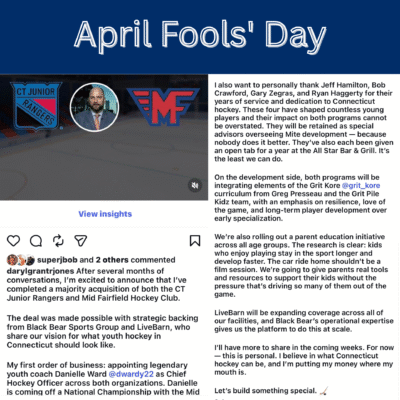
The language alone — straight out of Harvard Business School — should have been the giveaway.
It wasn’t.
It was congratulated.
It was criticized.
It was shared.
It was believed.
On April Fool’s.
Nearly ⅓ of the youth hockey registration in the northeast had seen the post in less than 24 hours.
That got us thinking:
Do people under pressure accept information faster?
Research suggests yes.
Which leads to a bigger question:
Are we living in a time of elevated anxiety?
Not the sharp, obvious kind — but something quieter.
Ambient anxiety: a persistent, low-level unease that isn’t tied to a specific threat, but subtly shapes how we perceive and respond to the world.
The Grit Kore Anxiety Index
To explore this, we combined market volatility (VIX) with Google search behavior to build the Grit Kore Anxiety Index
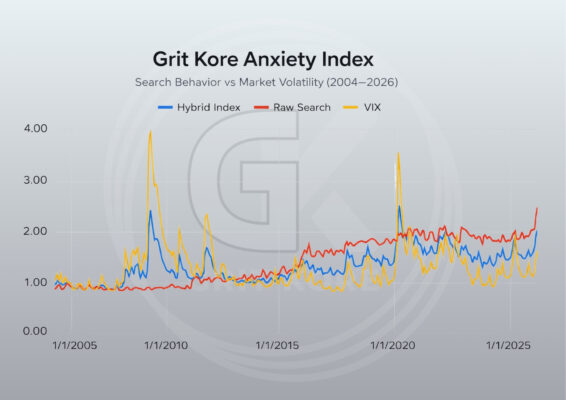
What we see:
- A noticeable rise beginning around 2015
- A step-change post-2020
- A new baseline of elevated ambient anxiety
Why this matters
A friend — whose father and brother both played in the NHL — shared something interesting.
Growing up, his mom constantly tracked what other prospects were doing.
Now that their careers are over… she follows politics with the same intensity.
The outlet changed.
The behavior didn’t.
So I asked him:
“Was that awareness helpful?”
His answer:
“No. If anything, it probably made things worse.”
The takeaway
Anxiety doesn’t just exist — it moves.
From hockey… to school… to careers… to politics.
And if we’re not aware of it, it starts to shape:
- how we think
- how we react
- how we parent
The challenge
As parents, coaches, and leaders, we need to recognize:
- Ambient anxiety is real
- It influences behavior more than we think
- We have a choice in how we respond to it
Take time to:
- move your body
- slow your mind
- create space
Because if we don’t…
this ambient anxiety doesn’t just affect us — it transfers to our kids.
Find. A. Way.
Greg
Related: Hockey Tryouts and Your Kid’s Identity — tryout season is when anxiety peaks most. Also read: How to Build Confidence in Youth Hockey. Browse more on the Hockey Parents Resource Guide.
Grit Kore Workbooks
Give Your Child a Real Mental Edge
The Hockey IQ workbook builds the mental game — confidence, decision-making, and game intelligence — through structured exercises your child can work through at home.
See all resources: Hockey Parents Resource Guide
Spotting It in Yourself Before It Spreads
Ambient anxiety is easy to miss because it rarely announces itself. It usually shows up as:
- Checking a rankings site or group chat more than once feels warranted.
- Reacting a little too fast to a piece of news, before checking whether it’s even true.
- Carrying tension from the rink into the car ride home, and from the car ride home into dinner.
None of these are dramatic on their own. That’s exactly why they’re worth noticing. The April Fools’ story spread as fast as it did because people under ambient pressure accept information faster, without pausing to check it. The same shortcut that made a joke go viral is the one that quietly shapes how we parent and coach on an ordinary Tuesday.
Frequently Asked Questions
What is “ambient anxiety”?
It’s a low-level, background kind of anxiety, different from the sharp, obvious kind. It doesn’t feel like a crisis in the moment, but it still shapes how we think, react, and parent.
What does the April Fools’ story have to do with hockey anxiety?
It was a live example. A joke about “acquiring” two youth hockey organizations spread to nearly a third of the region’s hockey families in under a day, showing how fast people under pressure accept and share information, true or not.
Does this kind of anxiety stay contained to one area of life, like hockey?
Not based on what we’ve seen. The pattern is that ambient anxiety moves, from hockey to school to careers to politics, carrying the same intensity into whatever the current focus happens to be.
What can parents actually do about it?
Small, deliberate resets: move your body, slow your mind, create space before reacting. If we don’t manage our own ambient anxiety, it transfers directly to our kids.
This article is part of our Mental Toughness & Grit: Complete Guide.

Pingback: Youth Hockey Tryouts and the Question of Identity - Grit Kore
Pingback: The Daily Gap: Building Youth Hockey Confidence