
Every parent in the stands, with full information and a 190 hockey IQ, has watched a play and asked, “What were they thinking?!”
At Grit Kore, we took that question seriously. After three years of serious research, numerous books and plenty of dead ends, one book pulled our thinking together: Neuroconstructionist Coaching by Ramon David, founder of the BrainFirst Institute. His work was written for coaches of people in work and life, not hockey. The hockey version is ours.
The short version
- A player’s brain doesn’t record the game like a camera. It predicts, and every player builds their own version of the play.
- Mites, Squirts and Peewees are still building their picture of the game, so what they learn first matters most.
- Hockey has a hierarchy of rules. Hard rules get the same correction every time; everything above them has to be safe to try.
- Hockey IQ grows through a four-step loop (predict, error, correct, adjust), repeated over thousands of shifts.
The brain predicts the game. It doesn’t record it.
Here’s the core idea. The brain doesn’t record the game like a camera. It predicts. Every player builds their own version of what’s happening on the ice, based on how well they know the game and what they care about in that moment. Two players can look at the same play and see two different games.
“Change begins when we can see the architecture that constructs experience.”
Ramon David, Neuroconstructionist Coaching, p. 108
The database grows with every shift
For Mites, Squirts and Peewees, every rep adds to the database. Their picture of the game is still being built, so it changes fast. By Bantam and U16/U18, players have seen thousands of plays, so their brains predict more and check less. That makes their reads faster. It also makes old habits harder to undo, which is why what young players learn first matters so much.
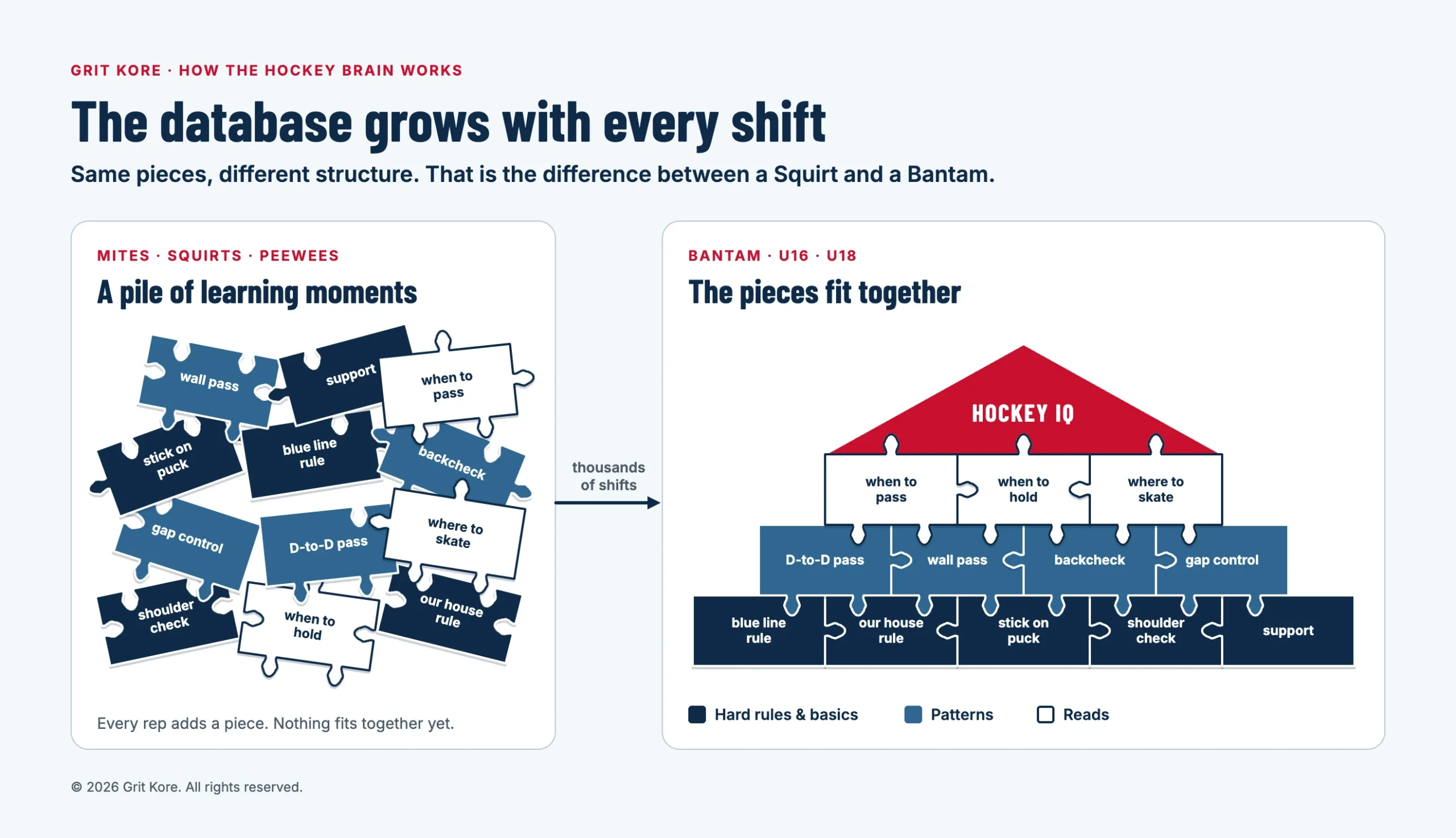
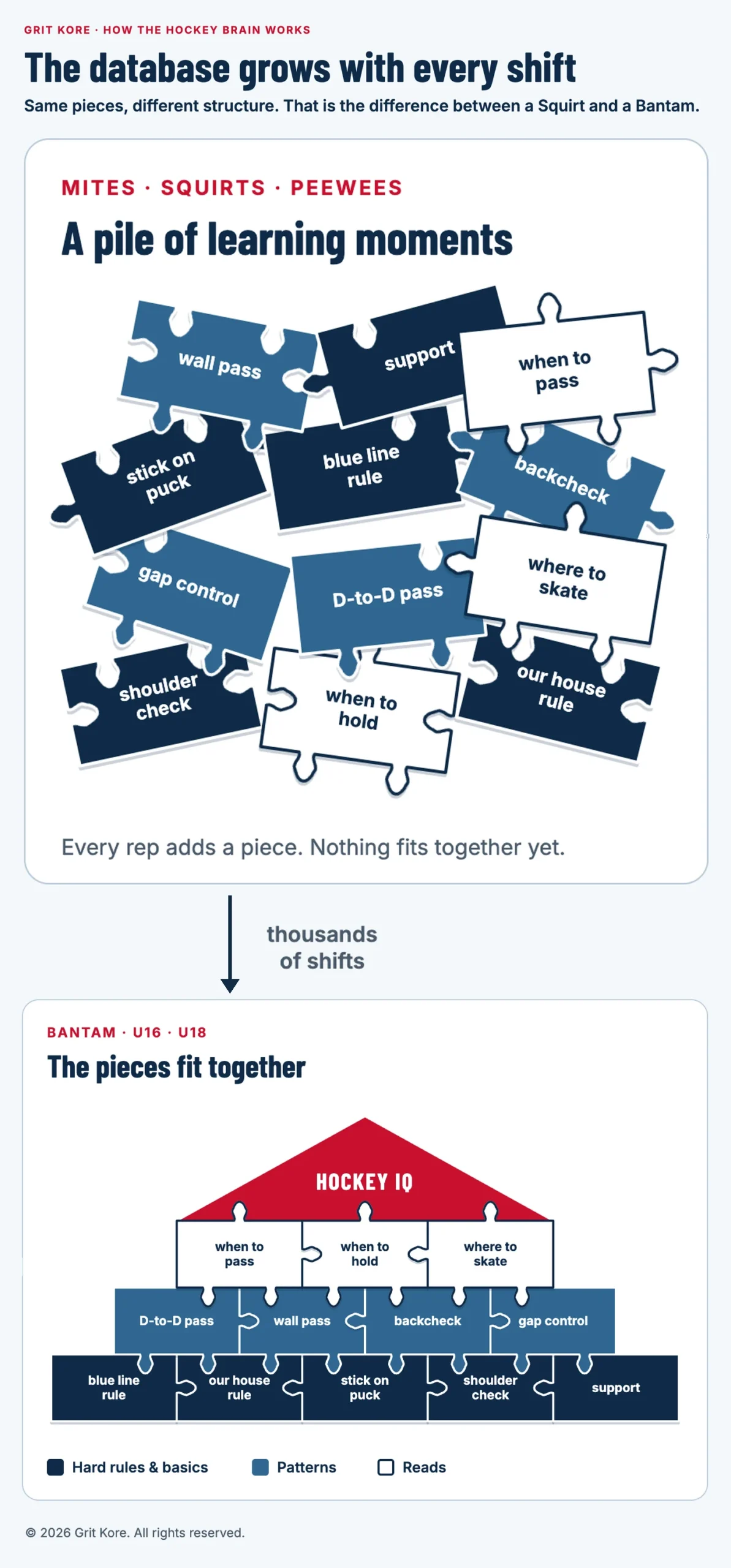
Same pieces, different structure. That’s the difference between a Squirt and a Bantam. (Tap the image to zoom.)
Not every mistake is equal
Hockey has a hierarchy of rules, and for youth players the top tier is hard rules: no messing around at the blue line through traffic, and no carrying the puck into our house (the middle of our zone, in front of our net) when the other team is there. Break a hard rule and there’s no consolation. There’s a correction, every time, the same way, until the player starts catching it themselves.
A recent Squirt game: one of our defensemen carried the puck into our house with forecheckers on him, turned it over, and they scored. He came back to the bench upset. No consolation, just the rule, short and clear. Next shift he made the right play under pressure, and he heard about that just as clearly.
Learning is a loop
Every shift, a player’s brain runs the same cycle:
- Predict: read the play and guess what happens next.
- Error: the play goes differently, or the execution misses.
- Correct: notice the gap, with a teacher’s help.
- Adjust: update the picture of the game.
Then repeat: next shift, next game, next season. Hockey IQ builds up from thousands of these loops.
Learning the concepts of hockey is a process of trial and error. Some mistakes are big and some are small. Hard rules get corrected every time. Everything above them has to be safe to try, or players fall back on safe, easy plays on autopilot.
Just like we don’t scream at kids when they’re learning new math concepts, we need to take a similar approach when teaching hockey concepts. So we repeat the process with patience. After a mistake on the ice, ask, “What did you see?” Explain the concept. Then ask, “What do you think you could have done?”
In this regard, we aren’t hockey coaches, but hockey teachers. And maybe that’s the way we need to change our identities on the bench.
The Grit Kore books are now available at Pure Hockey. Our Hockey IQ book, Hockey IQ – Four Attributes of Hockey, brings these ideas to Peewee and Bantam players. Find it online at Pure Hockey, at select Pure Hockey stores, or here in our shop.
Frequently asked questions
What is hockey IQ?
Hockey IQ is a player’s ability to read the game, make the smart decision, and stay composed under pressure. It isn’t fixed. It builds up from thousands of predict, error, correct, adjust loops, shift after shift.
Can hockey IQ be taught to youth players?
Yes. Every rep adds to a young player’s picture of the game, and for Mites, Squirts and Peewees that picture changes fast. What they learn first matters most, because by Bantam and U16/U18 old habits are harder to undo.
Why do young hockey players make plays that look wrong from the stands?
The brain doesn’t record the game like a camera. It predicts, based on how well the player knows the game and what they care about in that moment. A young player’s picture of the game is still being built, so they can look at the same play as a parent in the stands and see a different game.
What are hard rules in youth hockey?
Hard rules are the top tier of hockey’s hierarchy of rules. Two examples: no messing around at the blue line through traffic, and no carrying the puck into the middle of your own zone, in front of your net, when the other team is there.
How should hockey teachers respond to mistakes in youth hockey?
Break a hard rule and the correction comes every time, the same way, until the player starts catching it themselves. Everything above the hard rules has to be safe to try. After a mistake, ask “What did you see?”, explain the concept, then ask “What do you think you could have done?”
Keep reading
- Hockey IQ: The Complete Guide
- The Unifying Theory in Defining Hockey IQ
- Stop Saying You Can’t Teach Hockey IQ
- Hockey Parents: Complete Resource Guide
FIND. A. WAY.
Greg
Subscribe to new blog posts
Subscribe to get the latest posts sent to your email.
