
If you’ve ever found yourself in the lobby of a three-star hotel during a hockey tournament—with a few coaches, a couple of cold drinks, and too much time before the next game—you’ve probably heard one of hockey’s oldest debates about Hockey IQ:
Can you teach Hockey IQ?
We believe the answer is an emphatic yes—with one important caveat.
Like every other human ability, cognitive ability varies from person to person. Some athletes process information more quickly, some have greater working memory, and some recognize patterns faster than others.
Research supports this. A recent paper by Kirby, Jones, Campbell, Fickling, and D’Arcy, Objective Neurophysiological Measures of Cognitive Performance in Elite Ice Hockey Players, found measurable cognitive differences among elite hockey players. In other words, elite players possess different cognitive strengths that may influence how they process the game.
But different starting points do not mean Hockey IQ is fixed.
Think about algebra. Some students understand a new concept almost immediately, while others require more instruction and practice. Their rate of learning differs, but both can improve because the underlying principles can be taught.
We believe Hockey IQ is no different.
In an earlier post and our book, we defined Hockey IQ as the interaction of objective, flow, context, and individual ability. Every player has a different cognitive ceiling, but nearly every player can improve their Hockey IQ relative to where they begin.
So We Decided to Test Our Framework
Working alongside Coach Matt Moulson, we created a weekly Hockey IQ clinic that followed the progression outlined in the book. A typical session included:
- 5–10 minutes discussing nutrition and recovery.
- 20–30 minutes of video analysis focused on that week’s Hockey IQ concept.
- 60 minutes of on-ice drills designed to reinforce the lesson.
What Happened Surprised Us
The players didn’t just complete the drills—they began speaking a different language.
One day my son came home and said,
“Dad, the boys are talking about the Flow Line while they’re playing NHL. They’re calling each other out when someone breaks the flow.”
That was the moment we realized something had changed.
The players weren’t simply memorizing concepts. They had developed a shared framework for seeing the game. They were recognizing patterns, discussing decisions, and coaching one another without an adult standing beside them.
If you’ve played enough men’s league hockey, you’ve probably seen the opposite.
You’ve seen the incredibly skilled player who repeatedly attacks three defenders, pulls up on every zone entry, passes only as a last resort, or unknowingly kills offensive flow. His hands are exceptional, but he struggles to solve the game.
Those players can execute.
They can dazzle.
But skill alone isn’t Hockey IQ.
Hockey is about solving problems with five teammates in a constantly changing environment.
That’s Hockey IQ.
If youth hockey focuses exclusively on technical skill while neglecting decision-making, pattern recognition, and game understanding, we risk developing more skilled players who don’t necessarily play the game better.
We’re not suggesting every player has the same cognitive ceiling.
They don’t.
We’re suggesting that nearly every player can become a better hockey thinker than they were yesterday—and helping them do that is the responsibility of great coaching.
If we want to get serious about developing Hockey IQ, we need to become just as intentional about teaching players how to think as we are about teaching them how to skate, shoot, and pass.
Find. A. Way.
Greg
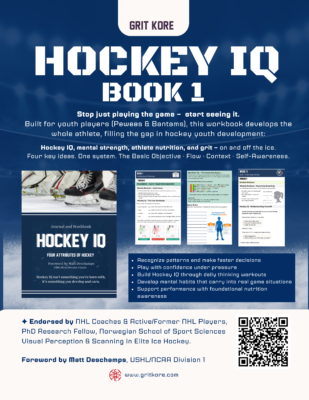
This workbook is available for coaches, teams, and individual players. We’re happy to share the email templates and resources we used to run these clinics—so any team can put this into practice. Reach out anytime. You can reach us at orders@gritkore.com, and browse the books available for purchase on our website.
This article is part of our Hockey IQ: Complete Guide.

Pingback: Athletic Development: Why Talent Alone Doesn’t Predict Success in Hockey - Grit Kore