
As a curious observer, I’ve always found it fascinating to watch how athletic development unfolds in young children on playgrounds and athletic fields.
Why are some children naturally fast?
Why do some seem exceptionally coordinated?
Why do others appear to learn movement almost effortlessly?
The easy answer is usually:
“Look at their parents.”
Or simply,
“It’s genetics.”
While genetics are undeniably important, the story is far more interesting than that.
What Actually Builds Athletic Capacity: The Roots of Athletic Development
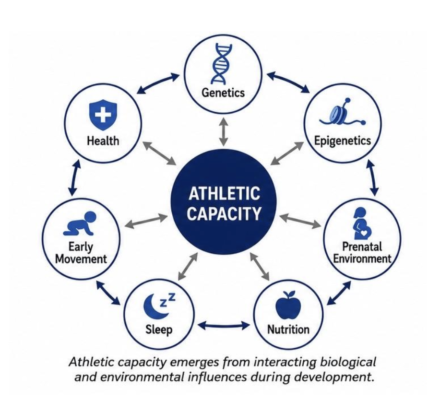
In Mismatch: Why Our World No Longer Fits Our Bodies, Peter Gluckman and Mark Hanson describe how our biology develops through a continuous interaction between genetics, epigenetics, and the environment.
That idea resonated with us.
Athletic capacity isn’t simply inherited—it emerges over time through the interaction of biology and early life experiences. Genetics matter. So do prenatal development, nutrition, health, sleep, early movement experiences, and other environmental influences.
One way to visualize that interaction is shown below.
The Story of Two Brothers
So what happens after athletic capacity begins to develop?
Consider two brothers born one year apart.
They grow up in the same home, with similar opportunities, similar nutrition, and similar encouragement. In fact, both become the fastest runners in their elementary school by fifth grade.
On paper, they appear remarkably similar.
But one discovers a passion for hockey.
The other discovers a passion for academics.
Over the next few years, their athletic journeys diverge—not necessarily because their athletic capacity changed dramatically, but because one chose to invest far more time, energy, and deliberate practice into sport.
This led us to an idea that has become central to our thinking.
Athletic performance is not simply a reflection of athletic capacity. It is the realization of that capacity.
Introducing the Development Gap
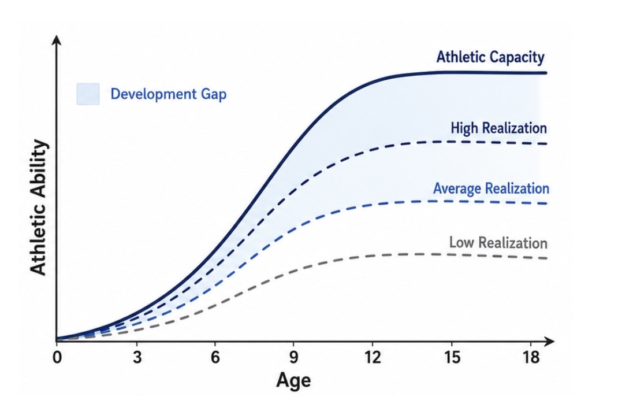
The space between an athlete’s capacity and their realization is what we call the Development Gap.
A coach cannot change an athlete’s genetics.
But a coach can profoundly influence how much of that athlete’s potential is ultimately realized.
Why Athletic Development Matters for Hockey Parents
If you’re raising a young hockey player, it’s easy to fall into one of two traps: assuming a naturally gifted skater is destined for greatness, or assuming a late-blooming, less coordinated kid has already been left behind.
Neither is true. Athletic capacity sets the ceiling, but coaching, environment, practice quality, sleep, nutrition, and mindset determine how much of that ceiling a young athlete actually reaches. That’s the Development Gap in action—and it’s also where Hockey IQ training, deliberate practice, and good coaching do their real work.
You can read more about how we teach it in Stop Saying You Can’t Teach Hockey IQ.
What’s Next: Can Late Bloomers Catch Up?
Next week we’ll take this idea one step further by exploring a question every parent eventually asks:
Can an exceptionally gifted athlete who starts later eventually overtake a slightly less gifted athlete who specialized early?
The answer may change how we think about talent, specialization, and long-term athletic development.
Common Questions Hockey Parents Ask About Athletic Development
Is athletic ability genetic, or can it be trained?
Both. Genetics set a starting point, but athletic capacity develops through the ongoing interaction of genetics, epigenetics, and environment—including prenatal development, nutrition, sleep, health, and early movement experiences.
What is the “Development Gap” in youth sports?
The Development Gap is the space between an athlete’s natural capacity (their ceiling) and their realization (how much of that capacity actually shows up in performance). Two athletes with similar capacity can end up with very different results depending on practice, coaching, and environment.
Can a coach really change how good an athlete becomes?
A coach can’t change an athlete’s genetics. But great coaching—paired with Hockey IQ training, deliberate practice, and the right environment—can close the Development Gap and help a young player realize far more of their natural potential.
Find. A. Way.
Greg
This article is Part 1 of our Athletic Development series. Part 2 tackles specialization, late bloomers, and long-term athletic development in hockey. We’re happy to share the resources and frameworks referenced here—reach out anytime at orders@gritkore.com, browse our Hockey Parents resource hub, and check out our Hockey IQ books and training tools in the Grit Kore shop.
