
Start here with the basics. From the Nutrition IQ appendix in the Hockey IQ book.
From the locker room: Everyone seems to talk about nutrition these days. Parents are trying to figure out their own stuff, coaches are telling us to fuel up before games, and you see ads on social all the time. Cool. I get it. But nobody actually said what it does.
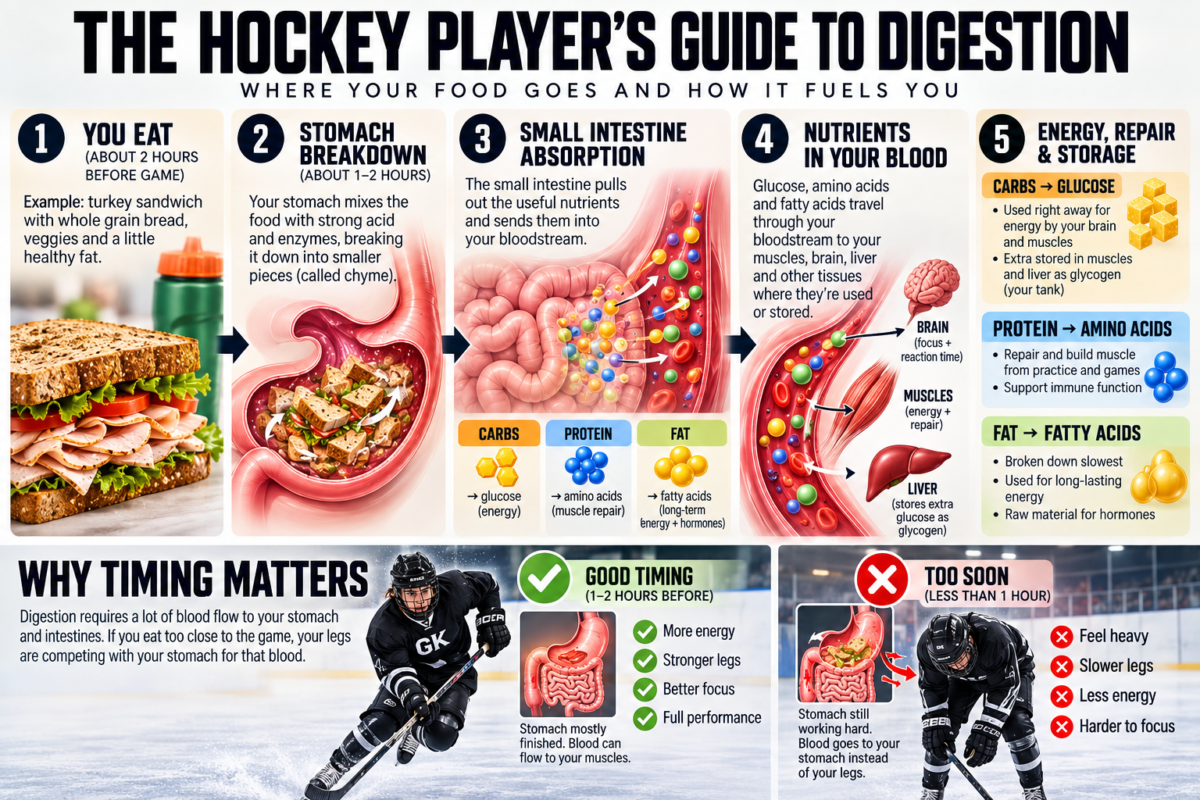
The rule: Food isn’t fuel until your body finishes turning it into fuel. That takes time, and different foods take different amounts of time. Everything else in this series (what to eat before a game, between games, after) comes from that one idea.
What actually happens: You eat a turkey sandwich. Your stomach breaks it down for about an hour or two. Your small intestine pulls out the useful parts and sends them into your blood. Carbs become glucose, which is the sugar your muscles and brain burn. Some of it gets used right away; the rest gets stored in your muscles and liver as glycogen, which is the tank you skate on. Protein becomes amino acids, which repair the muscle you tore up in practice. Fat gets broken down slowest and becomes long-lasting energy and the raw material for hormones. While all this is happening, your body sends blood to your stomach to do the work. That’s the whole reason timing matters: if your stomach is still working when the puck drops, your legs are competing with your stomach for blood. Your stomach wins. You feel heavy.
Speed, in order: Simple carbs (banana, applesauce, white bread) are in your blood in 15–30 minutes. Complex carbs (oatmeal, brown rice, whole grains) take 1–3 hours and release slower. Protein takes 2–4 hours. Fat takes the longest, 4 hours or more, and slows down everything it’s mixed with. So a banana is a 15-minute snack, a rice bowl with chicken is a 2–3-hour meal, and a bacon cheeseburger is a 4-hour project. None of them are “bad.” They’re different tools.
The three macros, and their jobs:
🟥 Protein builds muscle, repairs tissue, supports recovery. Chicken, turkey, fish, eggs, Greek yogurt, milk, beans, lentils, tofu, lean beef. Best spread across the day and after training, not right before a game.
🟨 Carbohydrates are your main energy source for a sprint sport. Two kinds: steady (oatmeal, brown rice, quinoa, sweet potatoes, whole-grain bread, beans) for meals and earlier in the day, and quick (white rice, pasta, white bread, potatoes, bananas, applesauce, juice, sports drinks) for close to and during games.
🟧 Fats are long-lasting fuel, brain function, and hormones. Unsaturated is best most of the time: olive oil, avocado, nuts, seeds, nut butters, salmon. Limit butter, cheese, whole milk, fatty meats. Not before games, because fat is slow.
The other two colors:
🟩 Vitamins and minerals do the small jobs that decide games. Potassium (bananas, potatoes, yogurt) helps prevent cramps. Magnesium (nuts, seeds, whole grains) helps muscles relax. Iron (red meat, chicken, beans, spinach) carries oxygen to your muscles. Calcium (milk, yogurt, cheese) builds the bones you land on. Vitamin C (oranges, berries, peppers, broccoli) helps you recover. Vitamin D (fortified milk, eggs, fatty fish, sunlight) supports bones and muscles.
🟪 Antioxidants are the cleanup crew. Training creates stress inside your muscles; antioxidants clean up after it. Blueberries, strawberries, cherries, oranges, spinach, kale, broccoli, peppers, carrots, sweet potatoes. You don’t need a powder or a pill. Eat the colors.
🟦 Water is what all of it moves through. Even mild dehydration slows reaction time. Drink all day, not just at the rink.
How much: For ages 11–15, roughly 0.7–0.9 g of protein per pound of body weight per day (a 100 lb player is 70–90 g), 2–3 g of carbs per pound (more on practice and game days), and 20–30% of your calories from fat, mostly unsaturated. Those are guidelines, not homework. You don’t weigh anything. You just make sure the plate has all the colors and the carbs get bigger on game days.
What this means on the ice: Full stomach, slow legs. Quick carbs close to puck drop, slow food far from it. Protein after, not before. Fat on rest days and after games. Water always. Every post in this series is one of those sentences, expanded.
The habit: Look at your plate before you eat and count colors. 🟨 carbs, 🟥 protein, 🟩🟪 something from a plant, 🟦 water. If a color’s missing, add it. That’s the whole system, and you can do it at home, in the dining hall, or at a Chipotle.
Make it: The Color Plate. Tonight, build one: rice or pasta (🟨), chicken, eggs, or beans (🟥), any vegetable or fruit (🟩🟪), a few nuts or some avocado on top (🟧), a glass of water (🟦). Five colors, ten minutes, and you’ve done what the whole appendix is about.
Everything here is from the Nutrition IQ appendix at the back of the Hockey IQ book. Next: What to Eat Before Puck Drop. Back to Fuel.
FIND. A. WAY.
