
While watching an NHL game with my son the other night, I caught myself trying to explain something most fans never even notice: how acceleration works on the ice, and why great players are constantly managing the natural delay it creates in the rhythm of the game. One simple question led to another, and, if you’ve been following our blog, you know exactly what happens next. I had to dig deeper.
Pretty soon I was knee-deep in physics, breaking down the difference between on-ice and off-ice acceleration so we could visualize it clearly and help young athletes understand why it matters for their game.
And here’s the big takeaway:
Acceleration on skates is not the same thing as acceleration in sneakers.
Not even close.
Understanding that difference can completely change how a kid reads the game, positions themselves, and makes decisions under pressure.
Let’s dig in.
1. The Physics Are Completely Different
Off the ice — running on turf — you have something incredibly valuable on your side:
Grip. High friction. Instant response.
You plant your foot, push hard, and the ground gives you exactly what you put into it.
On the ice?
Low friction and glide.
The skate blade slides before it bites, forcing you to use edge angles, hip rotation, and controlled pressure to generate force.
This is why a kid who looks explosive in sneakers might not look explosive on the ice — and why another kid who looks average during dryland suddenly becomes electric when the blades hit the sheet.
2. A Simple Comparison: Runner on Turf vs. Skater on Ice
To really make this clear, let’s compare the same movement:
A full-speed stop → turn → re-acceleration back to full speed
We’ll assume both the runner and skater approach at the same speed (6 m/s, about 13.4 mph).
Runner on Turf
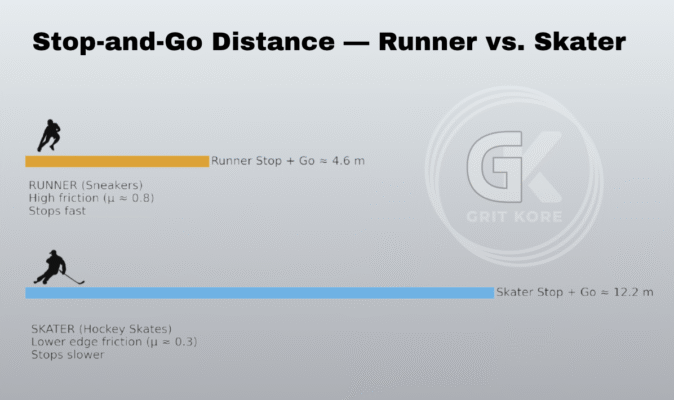
- High friction (µ ≈ 0.8)
- Can stop fast and push off again almost instantly
- Total stop+go time: ≈ 1.5 seconds
- Distance needed to complete stop+go: ≈ 4.6 meters

Skater on Ice
- Even in a strong hockey stop, friction is much lower (µ ≈ 0.3)
- Takes longer to create enough bite to decelerate
- Total stop+go time: ≈ 4.1 seconds
- Distance needed: ≈ 12.2 meters
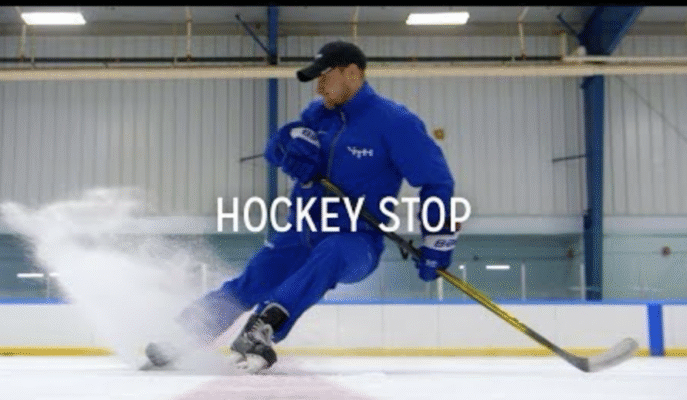
In other words:
A skater needs about 3× more time and 3× more space to perform the same stop-and-go as a runner.
That difference affects every read, angle, and decision in hockey.
Here’s the visual we created to make this clear:
In the coming weeks we’ll explore how the most effective zone entry tool in U8 hockey — the toe drag — becomes a handicap at older ages unless players understand transition times. Without adapting to changes in momentum, timing, and space, what once worked effortlessly can actually disrupt team flow and create vulnerabilities.
Find. A. Way.
Greg
What This Means for How You Coach and Watch the Game
Once you see the 3× number, it’s hard to unsee it on the ice. A player who looks “slow to react” on a turnover may not be slow at all, they may simply need the extra distance and time their skates require to convert a stop into a new burst of speed.
That reframes a few common coaching moments:
- Zone entries: skaters can’t cut on a dime the way a runner can, so reads and angles have to account for the extra ice needed to change direction.
- Backchecking: closing the gap after a delayed transition isn’t a hustle problem, it’s often a physics problem.
- Evaluating “quickness”: a kid who looks explosive off the line in dryland testing may still need real ice time to translate that into game-speed transitions, because the two movements draw on different mechanics entirely.
None of this replaces effort or conditioning. It just means the eye test alone can be misleading, understanding the physics helps parents and coaches separate a genuine effort issue from a simple mechanics-of-skating issue.
Frequently Asked Questions
Why does acceleration on skates take so much longer than running?
Because ice offers far less friction than turf, roughly µ ≈ 0.3 versus µ ≈ 0.8. Skaters need about 3 times more distance and time than runners to complete the same stop-and-go move.
Does this mean a kid who’s fast off the line in dryland training will automatically be fast on the ice?
Not necessarily. Off-ice acceleration and on-ice acceleration use different mechanics, so a kid who looks explosive in sneakers still has to build the specific skating movements that translate that quickness onto the ice.
How does this affect coaching decisions in games?
It reframes how coaches read zone entries and backchecks. A player who looks slow to recover after a stop may simply be dealing with the extra distance skating requires, not a lack of effort.
What’s coming next on this topic?
A closer look at how the toe drag, one of the most effective zone-entry tools in U8 hockey, can become a liability at older ages once transition times and momentum start to matter more.
This article is part of our Hockey IQ: Complete Guide.
